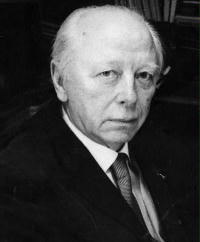
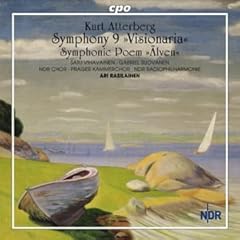
 Kurt Magnus Atterberg, born in Göteborg on December 12, 1887, is perhaps the greatest composer you've never heard of. (Yes, that ends in a preposition, because it sounds better than "of whom you've never heard.") By the time he died, he had composed five operas, nine symphonies, eight suites, five concerti, two ballets, and numerous chamber works.
Three weeks ago, I had the distinct pleasure of broadcasting nearly all of his recorded works (which is but a fraction of those he wrote). Occasionally when this or another blog puts forth a little-known modern composer, they do so with an explanation of why he's little known, and it usually reads like something along the lines of: "He was unfairly snubbed by the high-brow musical elite." Yet there is no such explanation for Atterberg: his well-constructed, tuneful music more often than not received glowing reviews; and his symphonies were programmed by what essentially amounts to the entire set of great conductors: Stokowsky, von Schillings, Nielsen, Nikish, Strauss, von Hausegger, Furtwängler, Toscanini, Beecham, Bruno Walter, and Eugene Ormandy.
So why have they disappeared? Who knows. But one can imagine that an audience attending a concert nowadays might be mesmerized by this.
That's just the exposition of the second symphony. (Granted, it's an extended one, with long arching melodies) What really separates Atterberg from those hundreds of merely good composers who write accessible music of a nationalistic nature is that he is always strict with his application of form: each theme is developed, finds itself fragmented, reversed, inverted, mashed in with the second theme, reduced to guttural howls or elevated to divine exaltation. For a long time, this second symphony, full of soaring hope, deep longing, and willful triumph, was far and away my favorite of his nine symphonies. Yet the one I find myself coming back to again and again is his ninth: the choral symphony (go figure). The theme here isn't a long melody, but a downward chromatic scale, and a leap of either a fourth or fifth, presented in the mezzo's entrance Jag Jätterna Minns ("I have the giants in mind").
The ninth symphony is very much an apocalyptic vision, taking as its subject the creation and destruction of the world, from the text of the Poetic Edda: The first war between Aesir and Vanir, the death of Balder, Odin's death, and the Ragnarok. While the music is far from atonal, there are dissonances abound as we are swept along the narrative, all the while this theme reappearing, sung by the baritone or chorus in inversion, or in reverse. By the time Rym, the world serpent, comes out from the roots of the Yggdrasil ("Rym styr un östern"), this chromatic descent and leap has transformed into this.
It's very Wagnerian: the theme that opened the narration, the creation of Midgård, becomes the theme of its destruction. It's a tremendous experience to listen to this symphony, especially with the libretto in front of you.
Now, about the performances from the cpo compact discs. Ari Rasilainen does a very fine job with the music, eliciting from the orchestras he directs the music's great power and majesty. Yet from time to time, the music seems in want of tenderness that isn't quite there in these performances, and certainly it would benefit from a more virtuosic orchestra. But, on the whole, these are very good performances, and I think very much worth exploring. It would be fantastic to see one of these symphonies performed, but until more people have made my discovery, I will content myself with these recordings.